
Thoughts on Pirates, Power, & the World of One Piece Through Social Accreditation Theory

How One Piece Uses Roles Like Pirates, Governments, Heroes, and Villains to Question Who Gets to Define Reality
I've recently been obsessed with the anime, One Piece, and how surprisingly well its story connects with some of the ideas I've been developing through Social Accreditation Theory. Although it's been around since the 90s, I never really got into One Piece as a kid, favoring other mainstream anime shows like Dragon Ball Z or Naruto. But since the recent live-action adaptation released on Netflix, the franchise has seen a remarkable surge in popularity; and thanks to implicit pressures from witnessing friends and co-workers speak so highly of the story and characters, I've watched 1162 episodes in less than a year’s time.
For anyone unfamiliar with the series, One Piece is adapted from a Japanese manga created by Eiichiro Oda that follows Monkey D. Luffy, a young pirate who sets out to find the legendary treasure known as the One Piece and become the King of the Pirates. On the surface, it's an adventure story about pirates sailing around a world made up of strange islands, fighting villains, making friends, and searching for treasure.
But underneath all of the ridiculous characters, superpowers, talking animals, giant sea monsters, and absurd comedy is a story that constantly asks questions about freedom, oppression, history, prejudice, authority, identity, friendship, and the legitimacy of social institutions.
More specifically, I think One Piece has a lot to say about accreditation.
<Spoiler Warning for the entire narrative of One Piece. Don't read if you aren't caught up!>
If you've read any of my previous SAT blogs, you probably already know what I mean by Social Accreditation. But as a quick reminder, Social Accreditation refers to the implicit and explicit processes through which people, groups, institutions, ideas, behaviors, and identities are validated or sanctioned according to the norms and expectations of a social environment.
A degree accredits someone as educated.
A badge accredits someone as an officer.
A crown accredits someone as a monarch.
A uniform can signify institutional authority.
A reputation can implicitly tell us whether somebody should be respected or avoided.
And labels like criminal, hero, terrorist, pirate, professional, expert, king, or even god all carry socially accredited assumptions about how we should perceive the people they describe.
What makes One Piece so interesting to me is that Oda spends the entire story constantly separating these accredited labels from the actual behaviors of the people who carry them.
The pirates aren't always the bad guys and the Marines aren't always the good guys.
Kings aren't necessarily legitimate rulers, and criminals aren't necessarily immoral.


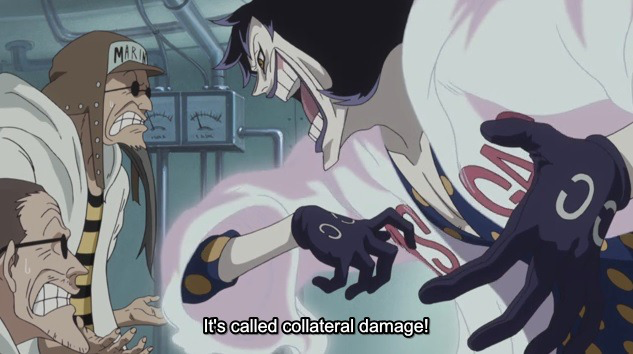


People who are publicly recognized as heroes may actually be exploiting the people they're supposedly protecting. And some of the characters who receive the harshest sanctions from society turn out to be the people most willing to fight for others.
This creates a really compelling fictional representation of what I like to call Accredited Reality. Accredited Reality describes the way socially constructed meanings can become so normalized and reinforced that they begin to present themselves to us as simply being part of reality.
We don't necessarily stop every morning and consciously decide that judges have legal authority, that money has economic value, that doctors possess medical credibility, or that governments have the right to issue passports. Those ideas have already been accredited through institutions, cultural practices, laws, traditions, symbols, and repeated social interactions. Eventually we internalize them so that they become part of the background conditions through which we understand the world.
And the world of One Piece works the same way.

One of the first things I found really fascinating about Luffy is that he's determined to become a great pirate even though his behavior rarely matches what we traditionally associate with piracy.
Yeah, he sails around under a pirate flag, searches for treasure, fights the government, accumulates a bounty, and openly tells everyone that he's going to become the King of the Pirates. But morally speaking, Luffy behaves strangely for someone who is supposed to occupy the role of a dangerous criminal.
Throughout his journey, he repeatedly encounters communities suffering under oppressive rulers and always ends up confronting and defeating those responsible. Throughout each arc, he rescues villages, protects his friends, battles slave owners, assists in overthrowing dictators, provides food to the starving, defends those abandoned or marginalized, and, most importantly, he rarely ever seeks any form of compensation in return.

Meanwhile, the Marines of the One Piece world are explicitly accredited as an institution of justice. They have ranks, uniforms, military authority, governmental recognition, laws, bases, bureaucratic structures, and an entire ideology organized around the concept of "Justice."
When someone becomes a Marine Admiral, the title itself communicates legitimacy. So we can assume this person possesses authority because an institution we recognize has granted them that position. But One Piece constantly complicates this.

Some Marines genuinely care about protecting innocent people, but others openly participate in corruption, censorship, political violence, slavery, and mass destruction.
So we're immediately confronted with a contradiction between institutional accreditation and lived behavior. The Marine has the accredited title of protector. But in One Piece it's typically the Pirate who performs the act of protection. That contradiction appears almost immediately in the story and becomes a running theme throughout. The Arlong Park storyline is probably one of the earliest examples where this becomes really obvious.
Nami's village has spent years being terrorized by Arlong and his crew. Nami herself has essentially been forced into labor for Arlong, using her ability to draw maps while secretly collecting enough money to purchase the freedom of her village.
But when she finally gets close to accomplishing that goal, Captain Nezumi, a corrupt Marine officer working with Arlong, confiscates the money by using his authority as a marine. This is such a simple example of the dynamics I'm talking about.

Nezumi possesses explicit accreditation. He wears the uniform. He has the rank and he represents the institution supposedly responsible for maintaining justice.
But the institutional token and his actual behavior don't align.
Luffy, meanwhile, has none of that legitimate authority. He's just a pirate.
Yet when Nami finally breaks down and asks him for help, he's the person who actually responds to the injustice. The iconic scene where Luffy places his straw hat on Nami before walking toward Arlong Park is especially important because the hat itself functions almost like an accreditation token.

Luffy received it from his idol, Shanks, who received it from the King of the Pirates, Gol D. Roger. The hat represents trust, legacy, aspiration, belonging, and eventually Luffy's own reputation as Straw Hat.
So when he places it on Nami, he's implicitly telling her that he recognizes her suffering, that he trusts her, and that she belongs within his circle of responsibility. Then he goes and destroys the system exploiting her by taking on the Arlong Pirates.
What makes the conclusion even more interesting is that Luffy receives his first bounty after defeating Arlong. Think about what happens there because its important. He performs an action that results in the liberation of a community, and the institutional response is to formally sanction him with a bounty.
But in the world of One Piece, that sanction also increases his reputation.
His bounty is meant to communicate: This person is dangerous.
Yet within pirate culture and among the people who know what he actually did, it begins communicating: This person matters.
The sanction becomes a form of validation depending on the arena in which it's interpreted.
I've come to think that the bounty system itself might be one of the clearest examples of social accreditation in One Piece.
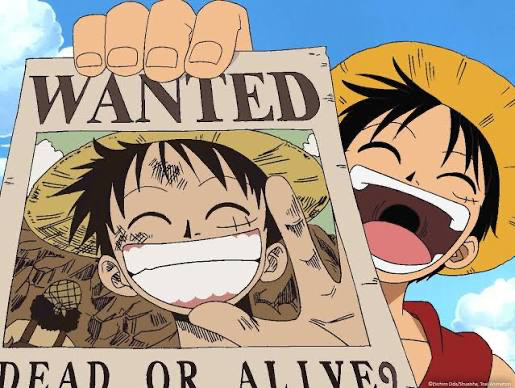
A wanted poster is obviously an explicit sanction. The World Government attaches someone's face to a monetary reward and publicly identifies them as a threat. But the higher Luffy's bounty becomes, the more social capital the bounty also gives him.
Other pirates recognize him. Powerful institutions begin paying attention to him. New potential allies know his reputation before meeting him, and greater enemies become envious and cautious around him.
His crew gains also status because of their association with him. In this sense, the Government's attempt to delegitimize him simultaneously helps legitimize him within other social networks.

This is something I think we see in real life all the time.
Social sanctions don't necessarily retain the same meaning when they move between groups. Being condemned by one community might actually increase someone's credibility within another. Someone can be regarded as a troublemaker by an institution and a whistleblower by their peers.
One group might describe someone as radical while another views them as courageous.
The accreditation token hasn't necessarily changed. But the accreditation body interpreting the token has. This is why accreditation is so contextual.
A token only has meaning because people agree, consciously or unconsciously, about what it signifies. And One Piece uses bounties to show this in an incredibly literal way. Through the bounty system, the World Government creates the very reputation it is attempting to suppress.

Luffy's family background makes his relationship with accreditation even more interesting.
He was raised under the influence of his grandfather, Monkey D. Garp, one of the most famous Marines in the world. While his father, Monkey D. Dragon, is the infamous leader of the Revolutionary Army. And Luffy himself idolizes the title once held by Gol D. Roger, the King of the Pirates.
So Luffy grows up surrounded by three completely different pathways toward social legitimacy. Garp represents institutional authority, Dragon represents revolutionary opposition to that institutional authority and Roger represents a kind of mythological legitimacy that exists almost completely outside conventional institutions.
But truthfully, Luffy doesn't really follow any of them. Garp wants him to become a Marine, but Luffy rejects that pathway. Dragon's revolution is probably closer to Luffy's moral behavior, but Luffy never defines himself as a revolutionary. And although he wants Roger's title, he doesn't appear interested in recreating Roger's life. Instead, Luffy decides what Pirate King means for himself. And this is one of my favorite things about his character.
When Luffy talks about becoming the Pirate King, he isn't really talking about ruling people.
He just associates the title with being the freest person on the sea. So there's almost a re-accreditation of the title occurring. Usually, when we hear the word "king," we think about sovereignty. But Luffy wants the recognition and title without really wanting domination or control. This becomes especially significant later because people repeatedly attempt to place Luffy into larger symbolic roles.
Captain of the Straw Hats.
Member of the Worst Generation.
Emperor of the Sea.
Joy Boy, Warrior of Liberation.
Nika, the Sun God.
Other people are constantly accrediting him as something larger than himself. But Luffy remains remarkably consistent in defining himself through his own relationships and desires. Luffy just keeps insisting that he's just Luffy and that authenticity is what leads each of his crew members to join him in achieving his dream.
I think Nico Robin's story might be one of the best examples of how sanctions become internalized. Robin grows up being told that she's dangerous and because of that, she's treated as a criminal from childhood.

The World Government gives her a bounty when she's still a little girl and frames her as someone who threatens the safety of the world. Just think about what that kind of accreditation would do to somebody psychologically.
She grows up inside an entire social reality where her existence has already been sanctioned. Wherever she goes, the token travels with her. People see the bounty and know the reputation. Even if they don't necessarily understand what the World Government says she represents and that explicit sanction causes them to ostracize her.
Eventually Robin begins to internalize this to the point that she expects abandonment. She believes her existence causes suffering for the people around her. And by the time the Straw Hats reach Enies Lobby, she's essentially accepted the idea that sacrificing herself might be better than allowing her friends to suffer because of her.
This is where Luffy's response becomes so meaningful. He doesn't try to negotiate Robin's legitimacy with the World Government. He doesn't ask the Government to reconsider her classification. He orders Sogeking to burn their flag.

The World Government says Robin is dangerous and should disappear. But the Straw Hats say Robin is our friend and we want her here. Symbolically, Luffy is rejecting their authority to make any final decision about whether Robin deserves to exist. And Robin is forced to decide which accreditation system she accepts.

When she finally screams that she wants to live, it becomes more than just a declaration of survival. It's almost an act of self-accreditation. For most of her life, other institutions have decided what her existence means. For once, she gets to say it herself. It also reaffirms her position with the Straw Hats, because Robin initially only joins the team after Luffy's refusal to let her die in Alabasta.
The more we learn about the World Government, the more obvious it becomes that their power isn't maintained through military force alone. They control information, classifications, and all legitimate institutions. But they also influence history. They decide what knowledge can be researched, which groups/islands receive protection and which groups can be sanctioned. And eventually we learn that even the political structure presented to the public isn't entirely real.

The Empty Throne is supposed to represent the idea that no single king rules over the entire world. It's an incredibly important symbolic token in the world of One Piece. The throne is empty because the world supposedly isn't ruled by one sovereign. But then we learn about Imu and the fact that there actually is someone sitting on the throne.
This is almost a perfect representation of Accredited Reality. The public symbol says one thing. But the actual power structure says something else. And the stability of the system depends on most people never discovering the contradiction.
This is what makes the Gorosei so interesting. For most of the story, the Five Elders appear to occupy the highest level of political authority. They're old men, shown sitting around in a room talking about global affairs, wars, pirates, kingdoms, and threats to political stability. At first, they seem almost bureaucratic, but gradually we realize that they're participating in something much more esoteric.
They know things about history that other people aren't allowed to know. They understand the significance of Nika. They participate in suppressing information about the Void Century. They answer to Imu. And they possess extraordinary powers that complicate our understanding of what the World Government even is. Once you hit the Egghead arc, their role starts to resemble something beyond ordinary governance.
This is why the destruction of Ohara is so important. The scholars and archeologists there aren't destroyed because they're physically powerful, instead they're labeled as dangerous because they're researching history. Their deviance is epistemic.
They want to know something that the existing accreditation system has classified as illegitimate knowledge. And once they get too close to discovering it, the World Government doesn't challenge their conclusions through debate. They destroy the entire island.
Robin is one of the only survivors, and the Government then accredits an alternative story about who she is. It demonstrates why controlling information is such an important form of accreditation.
If people never encounter the alternative narrative, they can't validate it. If they never hear the scholars' account of history, they can't compare it against the official account. If Robin is already introduced as a demon before anyone meets her, the sanction precedes the interaction.
This is one of the reasons I think One Piece feels surprisingly contemporary. We live in a world where we're constantly trying to decide which institutions, experts, governments, journalists, platforms, communities, and individuals deserve credibility. We're constantly exposed to competing interpretations of reality.
And increasingly, disagreements aren't only about whether a particular claim is true. They're disagreements over who has the authority to determine what should be considered credible in the first place. I don't think Oda needs to be intentionally commenting on any particular contemporary government or conspiracy for this comparison to work. The more interesting observation is that he's telling a story about the sociology of legitimacy.
This leads into what I think is one of the strongest connections between One Piece and the Accreditation Matrix. I've described the evolution of accreditation systems through a general movement between stability, tension, crisis, and transformation. During periods of stability, the accreditation system basically works.
People accept the relevant institutions. Tokens retain their meaning. Authorities are generally treated as legitimate. Sanctions discourage deviance. Validation encourages conformity. The social world feels relatively stable.
But contradictions inevitably emerge when the institution claiming to protect people starts hurting them. The king loses the trust of the population. The credential stops signaling actual competence. The laws stop appearing fair. Or when the official explanation of what's going on no longer matches people's experiences.
This creates accreditation tension. And One Piece does this over and over again at the level of individual islands.

In Alabasta, Crocodile manipulates events until the population begins losing trust in King Cobra.

In Dressrosa, Doflamingo maintains political stability through manipulated memories and hidden exploitation.

In Whole Cake, Big Mom orchestrates dastardly political agreements and foreign affairs through her large family of subordinate children.

In Wano, Kaido and Orochi maintain order through fear, isolation, scarcity, and violence.
In each situation, the ruling structure can appear relatively stable while enormous contradictions are accumulating underneath it. Eventually something happens that makes those contradictions impossible to ignore.
The suppressed history reappears through the Kozuki clan and Akazaya Nine.
The arranged wedding of Sanji and Pudding is ruined, foiling Big Mom's scheme.
The toys turn back into people and are freed from forced labor and colosseum fights.
The civil war erupts, the truth comes to light, and rain finally falls on Alabasta.
The oppressed population recognizes that the person they were taught to fear is actually helping them. The ruler they accredited is exposed and the supposedly illegitimate outsider becomes trusted. This is the point where social accreditation begins breaking down.
And I think this is important: A social system doesn't necessarily collapse when its government physically falls. Collapse can begin when its accreditation tokens stop producing belief.
A crown still exists. A uniform still exists. A title still exists. The institution still exists. But people stop believing that those things automatically signify legitimacy. The structure retains power while losing accreditation. That's the beginning of crisis.
This is why Luffy's role as a deviant is so important. Within Social Accreditation Theory, deviance doesn't necessarily mean immorality. It means deviation from an accredited norm.
Sometimes deviance is destructive. But sometimes the norm itself is destructive. And when that happens, deviance can become a strong force of transformation. Luffy is constantly violating legitimate authority. But the narrative repeatedly asks us to consider whether that authority deserves legitimacy in the first place.
Punching a Celestial Dragon is illegal. But what happens when the Celestial Dragon just shot Luffy's friend and participates in slavery?

Breaking into a government facility is criminal. But what happens when that facility is being used to destroy someone for researching history?

Overthrowing a ruler is destabilizing. But what happens when that ruler is starving or enslaving the population?

The question isn't why doesn't Luffy respect authority?
But, why should this authority be respected?
That's an accreditation crisis. The official token remains intact, but the moral meaning underneath it has collapsed.
This is probably the dynamic I'm most interested in exploring as One Piece moves toward its conclusion. Luffy and the Government almost represent opposite methods of producing legitimacy. The Gorosei operate from the top down. Their system depends on institutional hierarchy, inherited status, secrecy, bureaucratic authority, sanctions, classifications, and controlled information.
Luffy's legitimacy develops almost entirely from the bottom up. He meets someone.
He understands what they care about. He helps them. They begin trusting him.
That trust turns into friendship. Friendship becomes alliance. Alliances become reputation. Reputation becomes social capital. Eventually entire kingdoms, pirate crews, warriors, revolutionaries, and communities have some reason to believe in him.
And this happens even though Luffy rarely asks anyone to recognize him as an authority. The Straw Hat Grand Fleet is probably the funniest example. Luffy basically tells them that he doesn't want to command them. But they decide to follow him anyway.

His rejection of hierarchical authority actually produces more even more implicit legitimacy. That's almost the complete opposite of the Celestial Dragons, whose explicit legitimacy is enormous while their implicit moral legitimacy is often nonexistent among the people they exploit. Their system says: You will recognize my authority because of what I am.
Luffy's says: I don't really care whether you recognize my authority at all.
But Luffy is gradually becoming something larger than the individual person we've followed throughout the story. Other people are beginning to recognize him as Joy Boy or Nika and as a figure connected to an ancient historical struggle that Luffy himself barely understands.
This creates a strange tension. Luffy's power has always come from his ability to form direct relationships with people. But now he's becoming mythologized. People can potentially begin accrediting him without ever meeting him. Luffy the person becomes Straw Hat Luffy, the symbol. And once somebody becomes a symbol, the meaning of that symbol no longer completely belongs to them.
I've explored this elsewhere through the idea of accredited alienation: the possibility that somebody's genuine labor, creativity, identity, or purpose can receive recognition while simultaneously being transformed into something that no longer accurately represents what that person intended.
I think Luffy may be approaching something similar. He wants freedom, adventures with his friends and to become Pirate King. But the world may increasingly need him to represent liberation itself. That's a much heavier accreditation than anything Luffy has ever asked for. And it will be interesting to see how Oda resolves that contradiction.
Ultimately, I think this is why One Piece is such an interesting story to analyze through Social Accreditation Theory. For most people living within the world of One Piece, the World Government isn't experienced as some strange social construction, it's just the how the world works.
There are Marines and there are pirates. There are Celestial Dragons and there are revolutionaries. There are Kings and Emperors and Warlords and Slaves. There are known histories and forbidden histories. There are criminals and there are heroes. There are people whose authority is recognized and people whose existence is sanctioned. These distinctions all present themselves as normal.
But Luffy's journey keeps exposing the social processes underneath them. The king is only a king because people continue recognizing that authority. The World Government's history is only authoritative while alternative histories remain suppressed or unaccredited. The bounty only means "criminal" as long as people accept the Government's interpretation of the token. The Celestial Dragon is only untouchable because an entire institutional structure continuously enforces that status. And justice only retains legitimacy while the people exercising it continue behaving in ways that others recognize as just. Once those relationships become visible, what appeared natural begins appearing constructed.
And once something appears socially constructed, we can begin asking how it became legitimate in the first place.
Who validated it?
Who was sanctioned?
Who benefited?
Who conformed?
Who resisted?
What stories were preserved?
What stories disappeared?
What institutions gained enough credibility to decide which version of reality everyone else should believe?
Those are questions about social accreditation.

And I think they're also some of the central questions of One Piece. Oda has spent decades slowly showing us a world where the established order insists that its categories are permanent while nearly every major storyline demonstrates that they aren't. Again and again, oppressed people discover that the accredited version of reality doesn't match their lived experience.
That contradiction produces tension. Tension produces deviance. Deviance creates conflict. And eventually conflict creates the possibility for the accreditation system itself to be rewritten. Maybe that's what finding the One Piece will ultimately represent.
Uncovering something about the world powerful enough to break the credibility of the existing Accredited Reality. Because once enough people realize that the world they inherited was constructed through hidden histories, political institutions, myths, sanctions, titles, and carefully maintained systems of legitimacy, the question stops being whether the old world was ever truly natural. The question becomes what is everyone going to build after it falls apart?


Comments